

Land Grant Office of Sustainability
Vision
Our vision is to improve and enhance the lives of individuals, families, and communities of the Tohono O’odham Nation through holistic and culturally based formal and non-formal educational programming that is community-based.
Mission
Our mission is to empower the Tohono O’odham Nation’s citizens to reconnect to the land, language, and culture by embracing core values, preserving natural resources, and recognizing how our agricultural heritage informs our health and values.
Goals and Guidelines
- Initiate, develop, organize, and coordinate local community-based projects that improve economic development, natural resources, agriculture, and livestock.
- Ensure the health and well-being of O’odham land, water, natural resources, economy, community, and lifeways by promoting culturally relevant approaches to restoration, renewal, and sustainability in every endeavor and to disseminate this information.
- Collaborate with Tohono O’odham Community College departments to develop academic curricula that will prepare students for careers and provide professional advancement opportunities.
- Establish partnerships at all levels with governments, public agencies, educational institutions, nonprofits organizations, and private entities in order to pursue funding, conduct and implement projects, present educational events, and engage in other activities that serve the Tohono O’odham Nation.
TOCC Earns New Carnegie Sustainability Classification
 Tohono O’odham Community College (TOCC) has earned the new Carnegie Elective Classification for Sustainability, becoming one of the first 14 colleges and universities in the nation to receive the designation — and the only Tribal College recognized through the 2025 pilot program.
The new national classification recognizes colleges and universities that demonstrate how sustainability is integrated throughout the institution, including curriculum, research, operations, career preparation, and community engagement. TOCC will retain the classification for six years, through 2033. See the September 22 TOCC – The Nation’s Only Tribal College Selected press release or the Carnegie Elective Classification for Sustainability page for more information.
Sustainability (Cem hekid ‘am o himad–always will be continuing)
Tohono O’odham Kekel Ha-Maṣcamakuḍ (Tohono O’odham Community College) is leading an effort to develop a comprehensive sustainability plan for the college. This project will build on the Tohono O’odham cultural commitment to sustainability (Cem hekid ‘am o himad–always will continue), and concurrent efforts to formalize the college’s sustainability practices.
Project Overview
TOCC is interested in developing a sustainability plan that follows the best practices of sustainability research and efforts, rooted in Indigenous Ways of Knowing. The project will embrace the O’odham value of I-We:mta (Working Together) to seek out the voices of our campus community, students, faculty, staff, as well as Tohono O’odham Nation’s elders, surrounding community, and stakeholders to collaboratively co-create locally attuned, environmentally responsive, and culturally aligned recommendations related to the conservation of energy and other resources. In continuing efforts to be a responsible partner and steward of T-jewedga (Our Land) for managing its resources, TOCC desires to create and establish a sustainability plan to further our vision, goals and objectives in honor of T-Ṣo:ṣon (Our Core), T-Wohocudadag, (Our Beliefs), and T-Pi:k Elida (Our Deepest Respect).
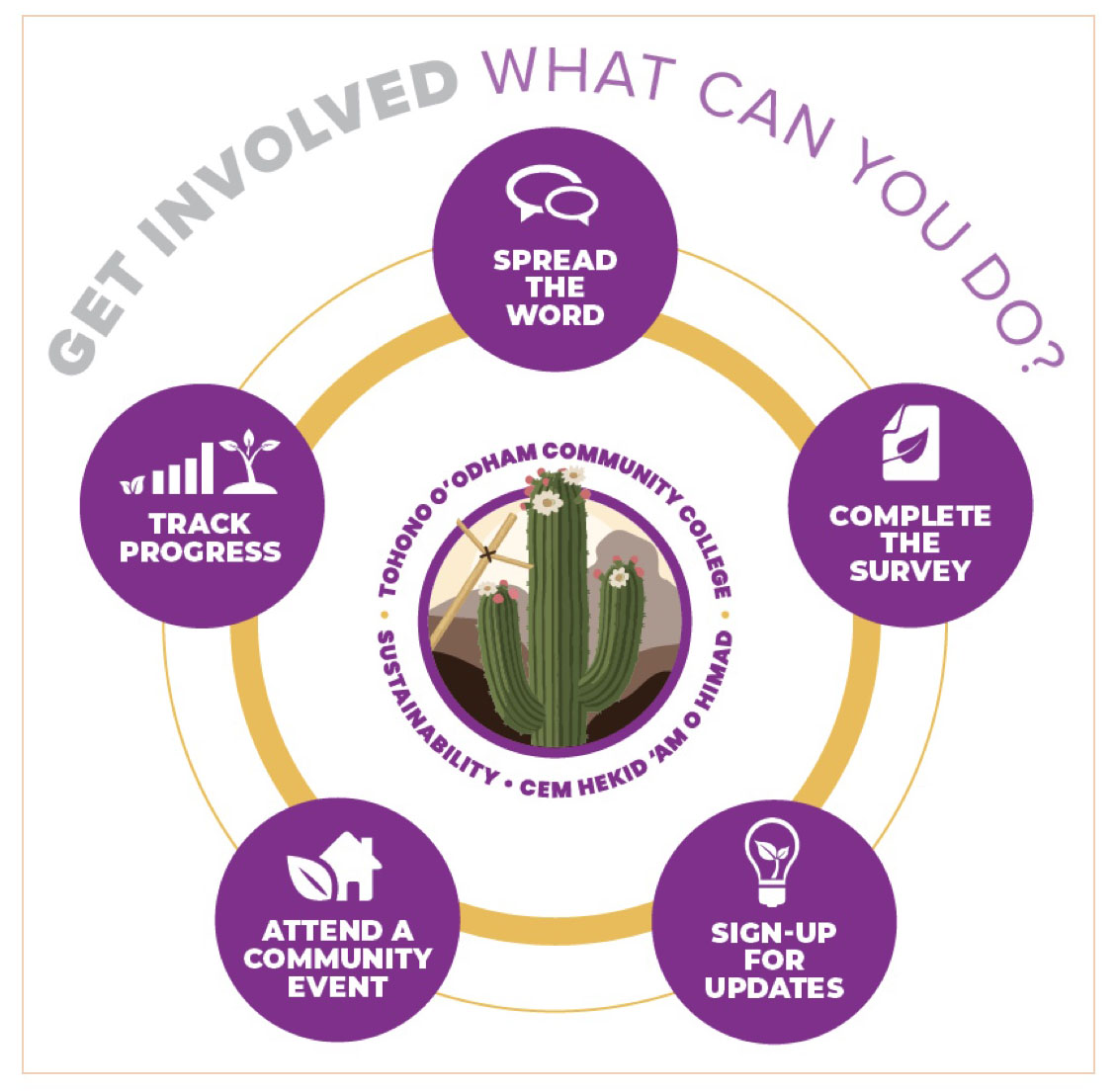
We Want Your Help The Tohono O’odham Community College invites you to contribute your perspective to the sustainability plan. Your input will serve to identify community priorities around sustainability action, which will ultimately influence which strategies are included in the plan.
- Submit the college community survey to help us better understand the sustainability priorities of our in-person and remote students, faculty and staff.
- Sign up to receive updates, attend an event, spread the word, or complete the survey.
- Share your thoughts and help guide our efforts to make Tohono O’odham Community College even better for generations to come.
Current Land Grant Programs (USDA-NIFA: Cycle 2022–2026)
Sovereign O’oidag (Gardens) for a Sovereign Nation
This grant addresses the Nation’s agricultural, youth, community development, and natural resource concerns. The activities also align with TOCC’s core values (T-So:son) which are strength and balance (T- Wohocudadag), wellbeing (T- Apedag), deep respect (T-Pi:k Elida), and working together (I- We:mta). Keeping with TOCC’s emphasis on Himdag, we are using Elders as primary instructors, advisors, and counselors for the youth programming. This grant aims to disseminate skills to prop tribal capacity for food sovereignty and to strengthen traditional ways of knowing and learning about agriculture. We launched a program of decentralized food gardens in the Nation’s districts and offered summer range camps to educate children aged nine to fifteen years old about land-water dynamics in the Nation’s lands. We are expanding the school gardening program with project requirements, including social jamborees in the wild food gatherings and weeklong tours of the Student Learning Farm. What is more, we will measure the amount of table-to-landfill waste from the Nation’s homes to develop a pilot composting program using the data from this project. Lastly, we augment our native seed stock by identifying, cataloging, and displaying plants used in traditional remedies, rituals, and foods.
Planting the Seeds of Culture and Food: Agricultural Experiential Education with Micro-Credentials
This project will increase TOCC’s capacity to offer agricultural and natural resources education based on culturally relevant practices, develop leadership and entrepreneurship skills, and support the regional economy of the Tohono O’odham Nation. TOCC proposes a culturally relevant experiential learning curriculum that connects participants with their community while building new skills. The curriculum is based on earning micro-credentials. These course sets take less time to complete, offer flexibility, and can lead to certificates in specialized agriculture and natural resources credentials within or without existing certificates and degree programs. The program also addresses developing entrepreneurial and leadership skills through community-based partnerships. Mentoring, shadowing, and job placement opportunities are available to micro-credential participants. We aim to build a new generation of Himdag-proficient community members who will contribute to producing fresh and healthy food and managing natural resources while creating business opportunities.
A Story of Sustainable Funding and Success
LGOS has undergone a significant transformation in its sustainability goals, a journey made possible by a diversity of grants from agencies such as USDA, NASA, the National Park Service, and the Native American Agriculture Fund (NAAF).
TOCC’s current “Sovereign O’oidag (Gardens) for a Sovereign Nation,” supported by a grant from USDA-NIFA, is a shining example of our commitment to revive and sustain Indigenous agriculture. Our O’oidag program has established community food gardens in different Tohono O’odham Nation districts to promote Indigenous nutrition with the traditional O’odham crops and continue the goals for local and sustainable food systems. The program, which includes community food gardens and summer range camps, promotes traditional O’odham crops and educates youth about climate-adapted traditional gardening. The O’oidag program also reaches the elderly and senior community members who maintain the traditional knowledge of the Nation.
LGOS is also developing community-based education through Micro Certificate Programs (MCPs), each designed in consultation with Tohono O’odham communities and Tohono O’odham Nation departments and funded by grants from USDA-NIFA and NAAF. MCPs are a relatively new educational concept gaining momentum with tribes nationally. MCPs are designed to provide student participants with the necessary skills and knowledge, including Traditional Ecological Knowledge (TEK), needed to become gainfully employed or start a business without leaving home. A few tribal colleges currently offer MCPs, one of them being TOCC. The objectives of the micro-certificate program are:
- To increase experiential learning opportunities by developing culturally relevant curricula and educational experiences that build a dynamic and engaging learning environment to instill entrepreneurship and leadership skills in agricultural and environmental fields.
- To offer professional career pathways that provide opportunities for direct employment of TON community members while keeping the road towards full degrees in higher education open.
- To invest in the necessary equipment and infrastructure to create career pathways that stimulate student entrepreneurship and business success.
- To recruit and retain students by eliminating barriers to participation, such as lack of time or flexibility.
Current Micro-Certificate Programs
The success of the micro-certificate program at LGOS is significantly dependent on our collaborative partnerships with TON departments, universities, non-governmental organizations (NGOs), and TON districts. These partnerships allow us to design courses and resources that are tailored to the community’s needs for training and employment. The current micro certificate programs at LGOS are a testament to this collaborative spirit.
Horseshoeing Micro-Certificate
Students participate for eight full-time weeks, receiving three credits/hour until completion of the course. Each graduate obtains a certificate of completion and equipment to start a business. This micro-certificate is part of the collaborative agreement with the Native American Horse Education Foundation (NAHE). This program also offers a two-week introductory horseshoeing for community members only interested in caring for their horses.
Natural Resources Micro-Certificate Program (NRMCP)
This program is a collaboration between TOCC, Arizona Conservation Corps (AZCC), the Tohono O’odham Nation’s Department of Natural Resources (TON-NR), and the Arizona-Sonora Desert Museum (ASDM). The Natural Resources Micro-Certificate (NRMCP) consists of one three-credit course and two four-credit courses, supported by a six-month hands-on field practicum for 12 credit hours. After this micro certificate, graduates can opt to be hired by AZCC, TON-NR, or ASDM.
12-Week Traditional Agribusiness Micro-Certificate
The Traditional Agribusiness is a 12-week program combining farm business management training with traditional farmer case studies. Students develop skills in record-keeping, spreadsheets, financial analysis, marketing, risk management, and responsible AI-assisted decision-making. The first six weeks provide integrated technical training, followed by six workshops featuring experienced farmers. The program emphasizes real-world data, profitability, resilience, entrepreneurship, and culturally relevant agricultural experiences to strengthen practical farm management and business decisions.
Land Grant Office Staff
